
Checking Criminal History in Fayetteville
Start with the event, not a broad name search. A police narrative answers different questions than a booking line or court docket. Fayetteville Police is the first stop for a report created by its officers. Fayetteville District Court is the local court channel for city criminal and traffic work. Washington County systems become relevant after booking or a circuit-level filing. Search ARCourts can then help track public court activity, while Arkansas Criminal History, known as ARCH, supplies the separate paid state product.
Use a legal name and narrow dates when possible. Case and report numbers are even better because people can share names. Follow this order:
- Ask the Fayetteville Police Records Division for the city case report and allow the normal processing period.
- Check Fayetteville District Court for a city criminal or traffic case tied to the event.
- Use the Washington County intake report or detainee roster when an arrest led to county booking.
- Search the correct Washington County court for later charges, hearings, and disposition.
- Use ARCH only when the Arkansas statutory criminal-history product fits the question.
Each result has a time frame. A fresh police report may exist before a prosecutor files a charge, and a custody record may remain visible while no final court outcome exists.
Fayetteville Reports Take Processing Time
The Fayetteville Police Records Division says case reports are usually available three to five business days after the incident. That timing is useful when a request made the next morning produces no record. It does not mean the event never occurred. The report may still be under review, or release may be limited because an investigation remains active.
Describe the incident date, place, parties, and case number if known. Ask what portion is currently releasable under the Arkansas Freedom of Information Act. A later request can be worthwhile when the first response cites an active investigation. Police reports can contain narrative facts that never appear in a jail roster, such as the call reason, officer observations, and property details. They still do not establish a conviction.
The official records page is also the source for the first Fayetteville image used here.
View the Fayetteville Police Records Division source before comparing the local request route.
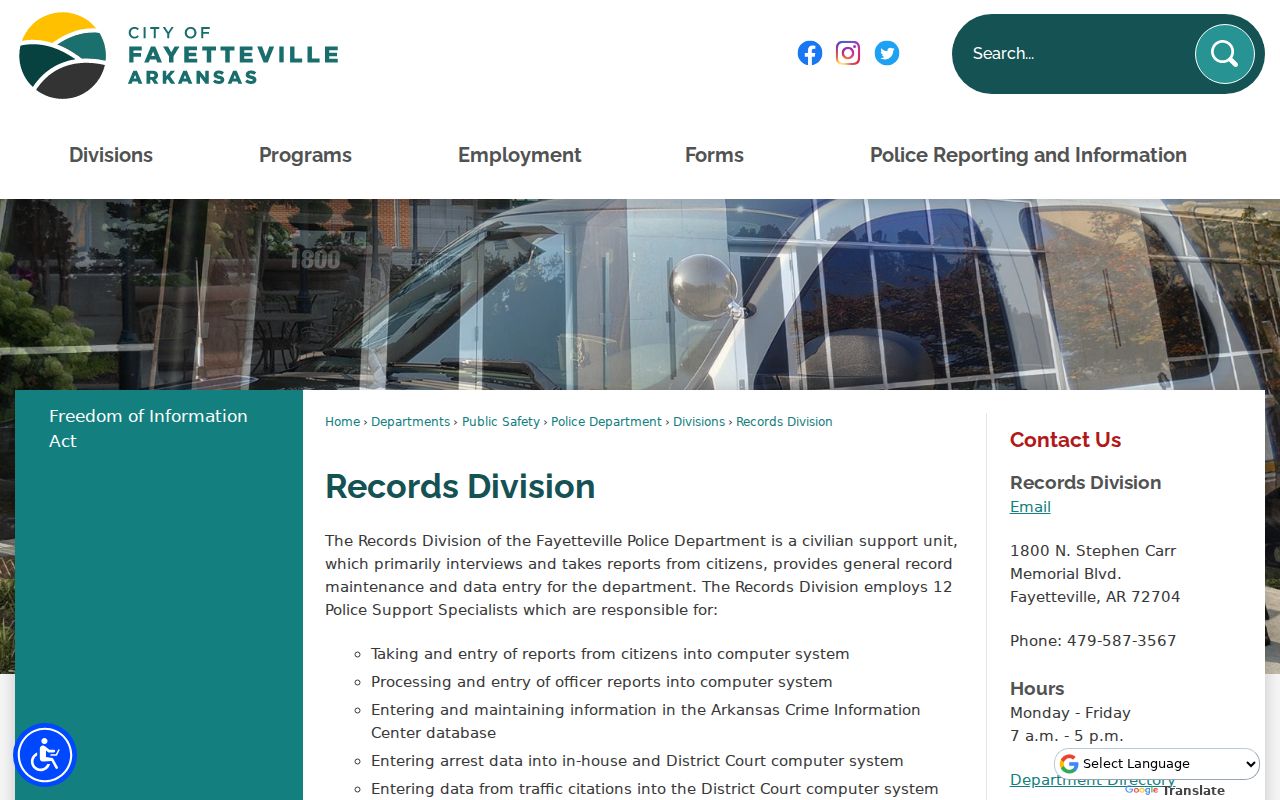
The captured page helps identify the city counter responsible for case-report access rather than county jail or court files.
Fayetteville Police Department Records
The Records Division is at 1800 N Stephen Carr Memorial Boulevard, Fayetteville, AR 72704. Its phone number is (479) 587-3567, and posted hours are Monday through Friday, 7:00 a.m. to 5:00 p.m. The division releases case and accident reports under Arkansas law, subject to restrictions. Calling first can clarify whether the report is ready and what identifying facts the request should include.
Fayetteville Police Records Division
1800 N Stephen Carr Memorial Boulevard
Fayetteville, AR 72704
(479) 587-3567
Monday-Friday, 7:00 a.m.-5:00 p.m.
A city police file stays with Fayetteville even when other parts of the matter travel elsewhere. The sheriff owns the county booking record, and the clerk owns the court case. This division of custody is the main reason one office cannot produce every item connected with an arrest.
Fayetteville Police and Jail Records Differ
Fayetteville is Washington County's largest city and the county seat, but a city record search is not the same as a county jail lookup. The police case report documents the local law-enforcement response. Once a person is delivered to the Washington County Detention Center, the sheriff creates a separate intake and custody record. That record can show intake, bond, charges, court dates, release, and current status.
Use the sheriff's Detention Intake Report for the last three days and the detailed Detainee Roster for current custody. A charge report may add bond and court-date style fields. None proves guilt. If custody has ended, the live roster may no longer answer the question, so a records request or court search may be needed. Broader county booking channels are covered in the Washington County arrest lookup.
Quick distinction: Fayetteville Police describes the incident; the sheriff describes detention; the court records the prosecution and outcome.
Fayetteville Arrests and Bookings
A Fayetteville arrest may appear first as a police event and then as a Washington County booking. The handoff is not instant in every system. Staff must complete intake, identify charges, and post custody fields. The city report may also remain within its three-to-five-business-day processing window. Searchers should note the timestamp on each official page before deciding that records conflict.
For very recent events, compare the Detention Intake Report with the detailed roster. Then move to Search ARCourts when charges have been filed. A court filing may use a different charge description than an initial booking entry because prosecutors decide what to file. Likewise, release from the detention center does not close the court matter. Fayetteville criminal records should be read as a sequence, not one frozen screen.
Note: An arrest, booking count, charge, and conviction are separate facts, and none should be substituted for another.
Fayetteville Prosecutor and Court Flow
The Fayetteville City Prosecutor investigates, prepares, and prosecutes city cases set for trial in District Court and Circuit Court. That role explains why a Fayetteville police report and a later charging document need not use identical language. Officers document the event. Prosecutors determine which supported charges to pursue. The court then records pleas, motions, hearings, judgment, and disposition.
City-level matters commonly begin in Fayetteville District Court. Felonies and other circuit matters belong in Washington County Circuit Court. The court named on a citation, summons, release paper, or Search ARCourts result is the safest routing clue. Do not assume that every event within the city belongs at the city court counter simply because Fayetteville officers made the arrest.
The city prosecutor's official page supplied a successful project image. Review the Fayetteville City Prosecutor source for the office's stated role.
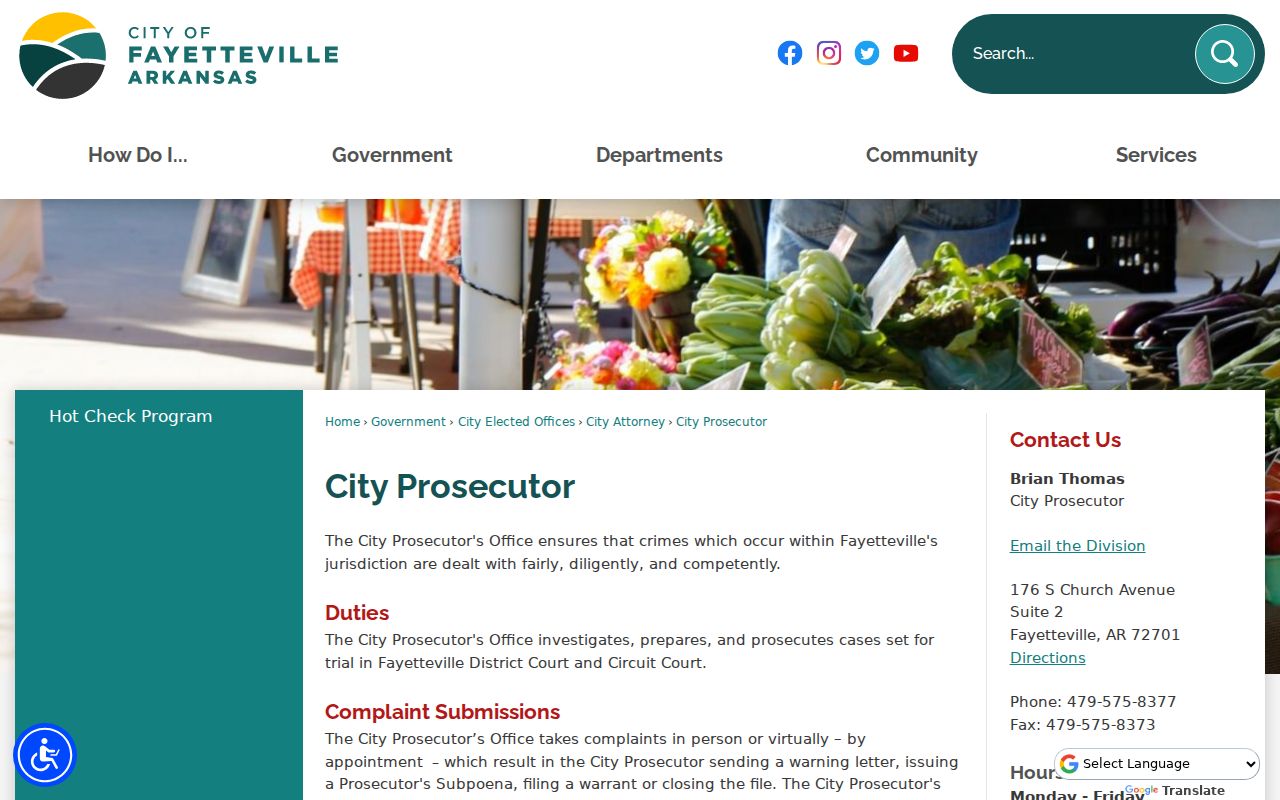
This view reinforces the distinction between police creation of a report and prosecution of a case in the proper court.
Municipal Court Records in Fayetteville
Arkansas calls the local court Fayetteville District Court. It is at 176 S Church Avenue, Suite 1, Fayetteville, AR 72701. The phone is (479) 587-3591, fax is (479) 444-3480, and posted hours are Monday through Friday, 7:30 a.m. to 4:30 p.m. Judge Clinton "Casey" Jones is listed on the city page. District Court handles city-level criminal and traffic matters, distinct from felony files held by the Circuit Clerk.
| Court Name | Fayetteville District Court |
|---|---|
| Case Types Heard | City criminal and traffic matters within district jurisdiction |
| Case Lookup Channel | Search ARCourts where available, followed by the court clerk for case-specific records |
| What the Docket Shows | Case identity, parties, charges or disposition, events, and judgments when public |
| Copies & Fees | Confirm the current copy process and charge with the filing court |
The Fayetteville District Court page is the source for the next image and contact details.
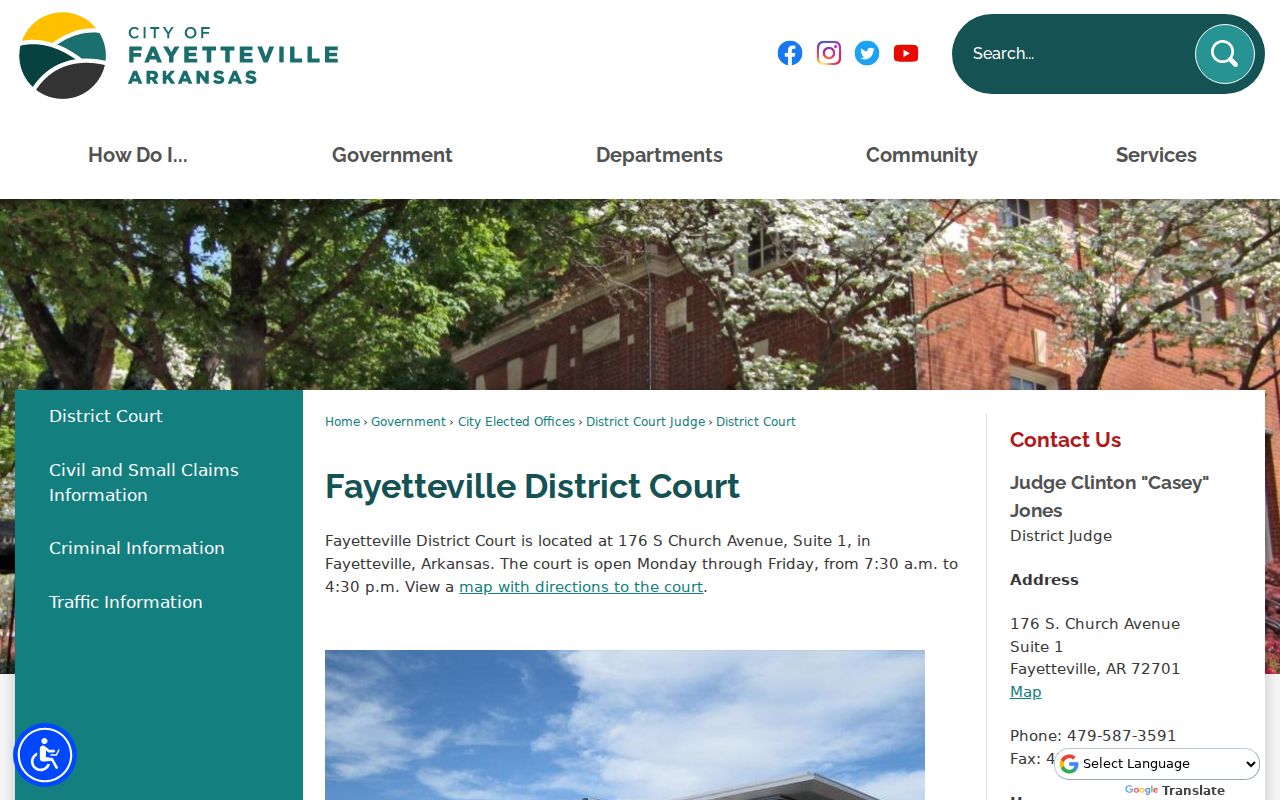
The city court page identifies the correct counter for local dockets while keeping Circuit Court records outside its scope.
Fayetteville Court Search Gaps
Search ARCourts may display parties, judge, filings, charges and dispositions, future events, judgments, and some public documents. It is a useful index, not a promise that every page of a Fayetteville case is online. Arkansas Supreme Court Administrative Order 19 keeps confidential material from public access. Sealed matters, juvenile files, protected identifiers, and other restricted content may be absent.
When the portal shows a case but not the needed document, contact the filing court. The Arkansas Administrative Office of the Courts answers portal questions, while the local clerk answers case-specific questions. This split prevents a common mistake: asking the statewide technology office to interpret or supply a Fayetteville filing held by the court.
- Disposition
- The final or current outcome recorded for a charge or case.
- Nolle prosequi
- A prosecutor's decision not to proceed with a charge.
- Bench warrant
- A judge's warrant, often tied to failure to appear or comply.
- Record sealing
- The Arkansas process that restricts ordinary public access after a court order.
Where Fayetteville Records Go
City and county systems receive different pieces of the same event. Fayetteville Police retains its report. A county detention booking belongs to the sheriff. Prosecutors file supported charges in the court with jurisdiction. The court clerk records the case and disposition. Qualifying arrest identifiers and dispositions then contribute to the Arkansas criminal-history system supported by the Arkansas Crime Information Center and operated through Arkansas State Police channels.
Record flow: Fayetteville Police Department › Fayetteville District Court or Washington County Circuit Court › Arkansas Department of Public Safety and Arkansas State Police
Recent activity is often clearest at the city or jail layer. A later court file is the better place for charges as filed and their outcome. ARCH is a separate $24 Arkansas name search and should not be read as a duplicate of either source. For a county-wide explanation of those layers, use the Washington County criminal history overview.
Fayetteville Scale Shapes Record Demand
Fayetteville is both the county seat and Washington County's largest city. The Census Bureau's July 1, 2025 estimate lists 94,309 residents. Its scale, university setting, and concentration of county justice offices create several valid places to look, but they also make counter selection important. The police building, city court, county courthouse, and detention center are not interchangeable offices.
The official Census QuickFacts page supplied the source for this population context. See Census QuickFacts for Fayetteville before using the estimate.
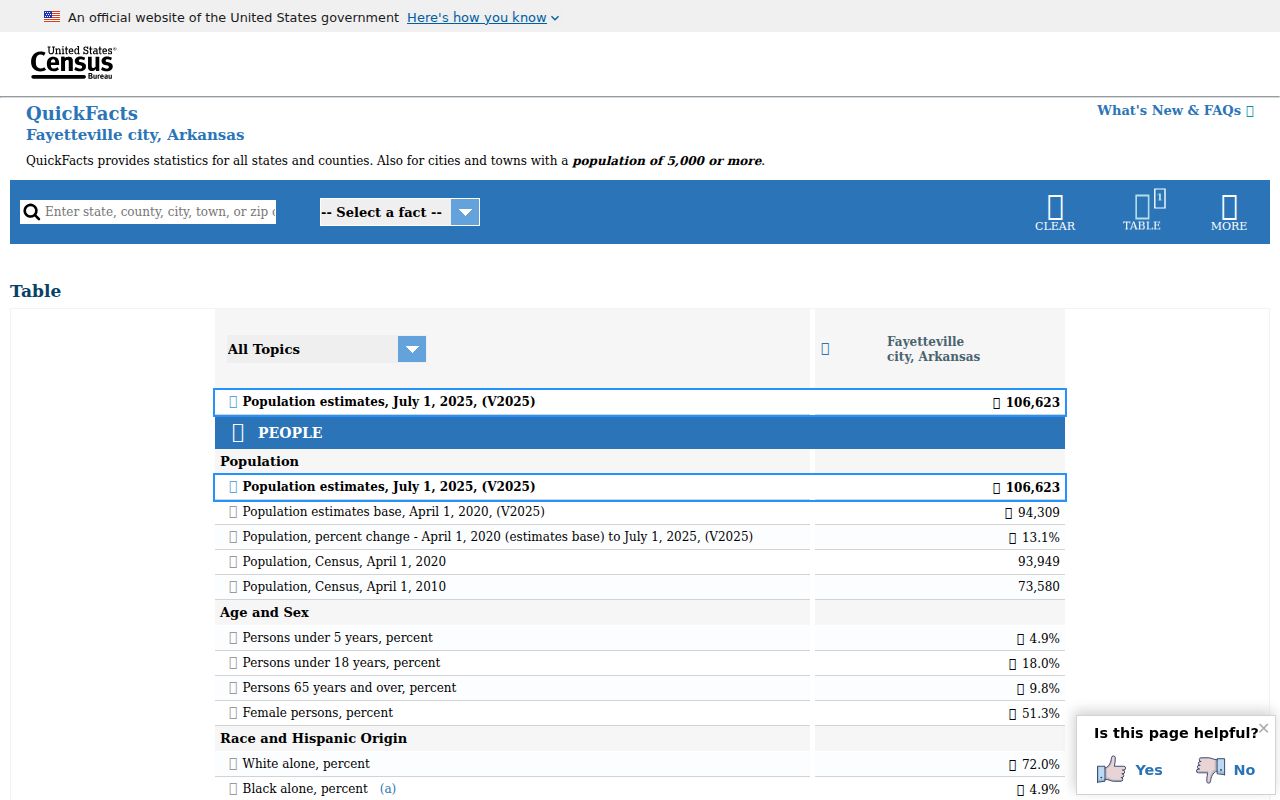
The city estimate helps explain why Fayetteville has distinct police, court, prosecution, and county-level record channels.
A searcher can reduce delay by naming the desired document. Ask Fayetteville Police for the incident report, District Court for a city docket, the Circuit Clerk for a felony file, and the sheriff for detention data.
Fayetteville Registry Safety Warning
Fayetteville Police also publishes a local explanation of sex-offender information. It says Fayetteville Police, Springdale Police, and the Washington County Sheriff's Office maintain registry information as a public service. The key local instruction is about use: registry data supports community safety and awareness, not action against a listed individual.
This channel is distinct from a Fayetteville police case report or District Court docket. Registry publication follows Arkansas risk-level and disclosure rules, and the absence of a broad public listing does not prove that no registration duty exists. Use the official Arkansas registry for the current public record and direct compliance concerns to law enforcement. Never use a registry entry to harass, threaten, or confront anyone.
Fayetteville's warning is valuable because it sets a plain boundary around a sensitive public record. It also shows why a lawful records search must match the record's purpose.
Public Access Rules in Fayetteville
Fayetteville police and court records are generally open only to the extent Arkansas law and court rules permit. The Arkansas Freedom of Information Act starts with public access but recognizes statutory and court-rule limits. An active investigation can restrict a police report. Administrative Order 19 controls access to court records. Sealed cases, juvenile material, victim information, and personal identifiers can be withheld or redacted.
Key Statutes:
Arkansas Freedom of Information Act generally opens public records unless an exemption, statute, or court rule applies.
Ark. Code Ann. section 12-12-1506 governs dissemination of conviction information and qualifying felony arrest records.
Arkansas Supreme Court Administrative Order 19 controls public access and confidentiality for court records.
Requesters should ask for releasable portions when a full report cannot be supplied. A denial or redaction at one layer does not authorize another office to disclose the same protected facts. Verify all material with the office that created or maintains it.